The last major event of that week was the early celebration of Megan's birthday. I have known Megan since I have known Berkeley- we lived on the same floor in the dorms. I have spoken to many people who hated dorm life, but I had a wonderful time and made what I hope will be lifelong friends there, and Megan is definitely among them. It was wonderful to celebrate her birthday here, and we had a great time, so you are going to have to suffer through a description of how to throw a party 3rd world style (we actually pulled off quite a lot). Megan had the inspiration to imitate one of the best college style parties: a room-to-room, in which each room has its own theme and the people who live there throw a "mini-party" of their theme before everybody moves on to the next room.
First was dinner: Vegetable curry and rice. Rice is not hard to find here, but a wide assortment of vegetables required a trip to Accra. The curry sauce contained three ingredients: coconut milk, sugar, and curry powder. It was amazing. The fresh smell that comes with cutting vegetables is especially aromatic when you haven't eaten them in a while. With big scoops of white rice (possibly my new favorite food)
We then moved on to Kelli and Elaine's fruit room. They had painstakingly sliced a beautiful array of fruits with Swiss Army Knives with NUTELLA in the middle (basically like liquid joy). I ate so much pineapple my mouth stung and I had to lay off of it for a week afterwards.
Next was Talia and Natalie's Tea Time, featuring honeybush rooibus tea, a wide variety of biscuits (the British did come to colonize, and while they didn't really leave a strong tea stamp, you can buy little packets of biscuits anywhere). It was lovely. Mac even brought out some fermented local alcohol that reportedly tasted like some combination of feet and ham. I don't hate myself enough to drink something with such a description, so we can't be sure
Finally was the Birthday room. Emily (Megan's roommate) decorated the room and welcomed everyone in by spraying them with silly string (the Ghanaians were really amused by that). We had chocolate birthday cake, and lollipops with whistles on the inside, and almost everyone from the program was in one room together for the first time in a long time. We focused mostly on appreciating Megan, but it was nice to survey a room full of people with whom I've shared so many wacky experiences. All in all, a very successful celebration.
Wednesday, April 2, 2008

Lizzie Leaves
The reason I could not stay to see the thief being punished (I'm not sure I would have wanted to anyway) was that I was meeting a friend, Lizzie for dinner. Normally, I would not take the time to tell you about each individual dinner I eat, but this was Lizzie's last dinner in Ghana. She is from San Francisco State and has been in Ghana since the end of last July. Due to progressively worse migraines, she eventually decided that it would be best for her long term health to go back home, and I wanted to have a meal with her before she left. Lizzie in many ways represented the benefits of coming second semester to lean on the students who have already been here and done so much. She was a wonderful reminder of San Francisco and taught me one of the most important lessons of being here: it's ok to have bad days where you feel like you are crazy and hate everything about such a new place. You bounce back, just be honest and nice to yourself. I hope that she has returned home safely and knows that she is appreciated here.
To see somebody actually going home also brought about a new flash of memory. For most of my day I don't think about Berkeley or San Francisco. I have fleeting memories, but I am mostly trying to stay in the moment and appreciate where I am. It was in many ways nice to hear Lizzie talk about the college friends she will see and the restaurants and sites she will visit (after the reverse culture shock subsides) in the city. I might just be able to balance loving home and loving it here.
To see somebody actually going home also brought about a new flash of memory. For most of my day I don't think about Berkeley or San Francisco. I have fleeting memories, but I am mostly trying to stay in the moment and appreciate where I am. It was in many ways nice to hear Lizzie talk about the college friends she will see and the restaurants and sites she will visit (after the reverse culture shock subsides) in the city. I might just be able to balance loving home and loving it here.
The Honor System
There are three noteworthy things that happened that week. The first was a spectacle I only caught part of as I was walking to dinner. Outside of the campus library, there were a huge number of students in red who were chanting loudly. I had to meet some people at dinner (see the next post) so I didn't stick around, but the event was later explained to me in detail by a friend who saw it all. A student was caught stealing a library book. You are not allowed to check out books from the library, and removing them is considered a serious offense because they are a very limited resource (the most recent books on water management were published in the late 1960s-early 1970s). As it turns out, any student who is caught stealing anything is given two options: the first is to accept being turned into the police, following which you are fined and expelled from school. It's important to remember that I'm not in the US here- this is one of a handful of universities, and if you get kicked out, there goes 20 years of hard work and being at the top of your class down the drain, plus you would disgrace your whole family. That's why every student choses option number 2: let Commonwealth Hall deal with you. Commonwealth is the all male dorm at the top of the hill on campus. They are very much the jocks in the traditional high school setting. A sign outside of the building reads "Welcome to Vandal City", and they are well known for being rowdy know-it-alls, but are respected by the rest of the student body. The way they punish thieves is quite a process. The elected "chief" of Commonwealth Hall drags a cart all around campus where the offender stands only in his boxers with his head hung in shame, surrounded by students wearing red- the Commonwealth Hall color. They stop in front of the library where students collect water and throw it at him- not in a fun water balloon fight kind of way, but in a way where the water snaps, leaving welts on the skin. Finally, the group converges and dumps the thief into the pond by the library. I would be interested to assess how much biological activity goes on in that pond, because water never cycles through it and it has taken on an awful brown color. This whole process emerged after years of students complaining about thieves and the security guards on campus failing to direct resources to addressing the problem (they do, to be fair, have bigger fish to fry). I don't want to give the impression that students here are constantly wandering around in a tribal fashion like they just emerged from the bush (they are in many ways more prim and proper than I am), but while this anecdote is in many ways not representative of life here, in some ways it really highlights that there are some traditions that nobody bothers to explain or justify, that just exist because that's the way things are supposed to be. Identifying those things makes studying abroad really interesting, and I wonder what kinds of weird rituals we have at home to which I don't give a second thought.
Happy ending to a bad day
That Thursday was just one of those days. I woke up with bad stomach cramps and my first bout with travelers' diarrhea. That was tons of fun. I pumped myself full of drugs until I could comfortably leave my room. I had to eat something so I could take my malaria pill so I ended up walking towards class planning to buy a big piece of dry white bread and some water sachets. I walked leisurely knowing I would be late, and stopped at the bank to withdraw money from the ATM where my card, without reason, was declined. I entered the bank to ask why and they told me they didn't know and I would have to go into Accra to the main branch with a copy of my passport so they could clear my name. Bad news: we had to submit our passports to the immigration office to get our visas extended to more than 2 months so I didn't have it. I fortunately had a 10 cedi bill, but nobody on campus accepts them because your average purchase is about 60 cents, and nobody wants to give so much change to one customer. Worn out, I asked the woman behind the desk if she would change that into 1s, which she begrudgingly did after accusing me of possessing counterfeit money. No fun!
 In order to improve the situation, I did not abort a plan that Ali, Natalie and I had made earlier that week- to bus to the Western region to hang out on the beach. I figured that if I was going to be lying down with stomach cramps, I might as well be in a place with a working toilet, good food and a beach front (for the mental health).
We packed and left that afternoon by STC bus and arrived in Takoradi that night. From there we took a taxi along the bumpiest most undeveloped road to the backpackers hostel we were hoping to stay at. A series of garbled text messages gave me the impression that they had a room available, and when we arrived, they said they were full. Given that the place was 10km from anywhere, I almost broke down sobbing, but they were able to open up space for us in tents that night. Relieved to find a place to rest our weary heads, we grabbed some sodas from the bar.
 My assessment was more than correct. Sleeping in a secluded tent on the beach listening to the ocean's pounding waves was so peaceful compared to a boy's college dormitory. I woke up refreshed and staked out one of the covered tables on the beach where we set up camp for the day. All of us, but particularly me, was happy to have a down day. The most exciting thing I did was to set up this slightly wobbly self-timing photo to show all of us happily together.
 I even felt good enough to snack on a breakfast of french toast and plantains with a little honey to sweeten it. Yummy, especially since all I'd eaten the day before was plain white rice.
 Ali went wandering down the beach to look for seashells, and both Ali and Natalie went swimming in the slightly turbulent Atlantic Ocean.
 Fortunately, I had been looking for an opportunity to finish Huckleberry Finn, so I spent a large part of the day lounging in a hammock. It really does help a tummy ache to spend the day on a lovely white beach. I also met a girl named Jess who just graduated from Stanford and had been traveling with friends and working at a nursery school and another man whose name I never got, but he was born in Germany and worked in England before going for his PhD in ecology and is now studying anthropology, doing work in a small village in the Western region. Interesting people.
 We lounged around until the sun set. Getting close to a real San Francisco sunset. It was so peaceful and wonderful. That night, the tents were also booked, but we had agreed to sleep on mats on the sand covered by mosquito nets. That was pretty uncomfortable, but we stuck it out.
 The next day we had planned to go see a stilt village. It was still a long way off, and I wasn't feeling 100%. Also, the hostel was going to charge 80 cedi to make it a day trip, which none of us were willing to do. So instead, we contributed to eco-tourism in a cheaper way by walking down the village and taking a guided canoe ride through mangrove forests. They are amazing plants, and it was again quite calm.
We saw some inland villages and met our guides, but also just soaked in the good feelings of being surrounded by green.
 Although the optimal time to see wildlife is early morning or evening, we went mid-day to break up the monotony of sitting on a beach, and saw some of the less appreciated wildlife like this crazy looking crab.
 We got back to camp, spent much of the afternoon in hammocks or at our table. We tried playing trivial pursuit, but it was British and from the 1970s, and since none of us knew which county the star cricket player at the time hailed from, we gave up pretty quickly. There was a bonfire that night, and some of the backpackers tried their hands at drumming (quite badly), but the Ghanaians took over much to my peace of mind. They were not able to "upgrade us to a tent" so we spent another quiet night under the mosquito nets on the beach.
 Sunday was our last day out there (we'd all agreed to miss classes on Monday to make it a long weekend). We hung out and ate at the Green Turtle (our hostel) and then moved our bags over to the Safari Lodge (the more upmarket option- costing each of us 10 cedi for the night). We were greeted back by the famous leaning palm tree, met some of the other guests who seemed to appreciate their personal space (very much not like backpackers).
 We then checked into a room with real beds! It feels really good after a couple of days on the ground.

We took a long walk on the beach to appreciate it one last time, came back, swam, showered, played Sorry, and had a wonderful fancy meal while cranking up the bar tab with some fancy drinks. The next day we woke up early, caught our taxi (who actually arrived on time) and brought us to the bus station. We caught the next air conditioned bus without a hitch, and ran into some friends of mine from the International Students' Hostel. We all traveled together (you are assigned a seat on the bus when you buy your ticket which means absolutely nothing), and then we all caught a taxi back to campus. My stomach recovered and we got another good night of sleep at home before Tuesday classes.
 In order to improve the situation, I did not abort a plan that Ali, Natalie and I had made earlier that week- to bus to the Western region to hang out on the beach. I figured that if I was going to be lying down with stomach cramps, I might as well be in a place with a working toilet, good food and a beach front (for the mental health).
We packed and left that afternoon by STC bus and arrived in Takoradi that night.
 From there we took a taxi along the bumpiest most undeveloped road to the backpackers hostel we were hoping to stay at. A series of garbled text messages gave me the impression that they had a room available, and when we arrived, they said they were full. Given that the place was 10km from anywhere, I almost broke down sobbing, but they were able to open up space for us in tents that night. Relieved to find a place to rest our weary heads, we grabbed some sodas from the bar.
 My assessment was more than correct. Sleeping in a secluded tent on the beach listening to the ocean's pounding waves was so peaceful compared to a boy's college dormitory. I woke up refreshed and staked out one of the covered tables on the beach where we set up camp for the day. All of us, but particularly me, was happy to have a down day. The most exciting thing I did was to set up this slightly wobbly self-timing photo to show all of us happily together.
 I even felt good enough to snack on a breakfast of french toast and plantains with a little honey to sweeten it. Yummy, especially since all I'd eaten the day before was plain white rice.
 Ali went wandering down the beach to look for seashells, and both Ali and Natalie went swimming in the slightly turbulent Atlantic Ocean.
 Fortunately, I had been looking for an opportunity to finish Huckleberry Finn, so I spent a large part of the day lounging in a hammock. It really does help a tummy ache to spend the day on a lovely white beach. I also met a girl named Jess who just graduated from Stanford and had been traveling with friends and working at a nursery school and another man whose name I never got, but he was born in Germany and worked in England before going for his PhD in ecology and is now studying anthropology, doing work in a small village in the Western region. Interesting people.
 We lounged around until the sun set. Getting close to a real San Francisco sunset. It was so peaceful and wonderful. That night, the tents were also booked, but we had agreed to sleep on mats on the sand covered by mosquito nets. That was pretty uncomfortable, but we stuck it out.
 The next day we had planned to go see a stilt village. It was still a long way off, and I wasn't feeling 100%. Also, the hostel was going to charge 80 cedi to make it a day trip, which none of us were willing to do. So instead, we contributed to eco-tourism in a cheaper way by walking down the village and taking a guided canoe ride through mangrove forests. They are amazing plants, and it was again quite calm.
We saw some inland villages
 and met our guides, but also just soaked in the good feelings of being surrounded by green.
 Although the optimal time to see wildlife is early morning or evening, we went mid-day to break up the monotony of sitting on a beach, and saw some of the less appreciated wildlife like this crazy looking crab.
 We got back to camp, spent much of the afternoon in hammocks or at our table. We tried playing trivial pursuit, but it was British and from the 1970s, and since none of us knew which county the star cricket player at the time hailed from, we gave up pretty quickly. There was a bonfire that night, and some of the backpackers tried their hands at drumming (quite badly), but the Ghanaians took over much to my peace of mind. They were not able to "upgrade us to a tent" so we spent another quiet night under the mosquito nets on the beach.
 Sunday was our last day out there (we'd all agreed to miss classes on Monday to make it a long weekend). We hung out and ate at the Green Turtle (our hostel) and then moved our bags over to the Safari Lodge (the more upmarket option- costing each of us 10 cedi for the night). We were greeted back by the famous leaning palm tree, met some of the other guests who seemed to appreciate their personal space (very much not like backpackers).
  We then checked into a room with real beds! It feels really good after a couple of days on the ground.
We took a long walk on the beach to appreciate it one last time, came back, swam, showered, played Sorry, and had a wonderful fancy meal while cranking up the bar tab with some fancy drinks. The next day we woke up early, caught our taxi (who actually arrived on time) and brought us to the bus station. We caught the next air conditioned bus without a hitch, and ran into some friends of mine from the International Students' Hostel. We all traveled together (you are assigned a seat on the bus when you buy your ticket which means absolutely nothing), and then we all caught a taxi back to campus. My stomach recovered and we got another good night of sleep at home before Tuesday classes.
Monday, March 31, 2008
Tradeoffs
We returned from the weekend in the village and I promptly went to bed. Not much happened during that week that is worth noting. I went to class, slept, ate Ghanaian food, and would come home to hang out in my hall or at the girls' dorm talking or watching a movie before bed. On one night, though, a few of the girls came over and we played a game of monopoly starting with the intention of taking a break to go to our open air night market to get food in the middle of the game. Jessica and I played on a team and promptly lost, (convincing ourselves that winning monopoly means you must be a ruthless and evil human being, so in the end we were the real winners), but in the middle of the game it started to rain outside. It quickly transitioned from light pitter-patter to a thousand-jackhammers-striking-the-ground-at-once sounding rain. Then on came the lightning. It struck twice in a row with such a dazzling flash, and the third strike was perfectly timed to coincide with a power outage- our first one of the semester. We lit candles and continued playing. Instead of actual dinner, we survived on pastries and ice cream sold at a small stand right by the door of our building instead of going out. It was such a seamless transition. And the flip side of the rain: we got running water all week (well, for about an hour each morning, but that's enough to fill up the toilet tank, the real drain on our water supply. Ooo, that might have been an overshare). I never thought that I would be weighing the pros and cons of water and electricity, two of the most stable utilities in the US (think about how pissed we get when the electricity blacks out for an hour or two, and I don't think I've ever in my life turned the tap and had no water come out until now). It was nice to realize a lower level of dependence, to continue playing monopoly and eating ice cream until bed time.
Also, to go back to the weather metaphor, the haze that has been so far omnipresent has began to fade away. We can start actually seeing the sun rise and set and there are discernible large puffy clouds and occasional bright blue skies. This is matching my transition from feeling completely boxed into a confusing new place to an up and down state of mind thinking in a single day how great it is to be in a new place experiencing black outs and water shortages and later cursing the world for the lack of the advanced infrastructure I'm used to in the US. Mood swings are just part of the process, but it's good to have glimmers of loving the place that you are.
A few more pictures
I stole these pictures from Elaine of our first lunch with Mary.
 Elaine helping stir the banku (fermented corn and cassava dough served with stew)
 The finished banku (we had to eat all of it, and it was very good but quite filling)

Mary, showing us old photographs of her family
 Elaine helping stir the banku (fermented corn and cassava dough served with stew)
 The finished banku (we had to eat all of it, and it was very good but quite filling)
Mary, showing us old photographs of her family
Adidopke (continued)
I am sorry to have cut off the rest of the story in the middle, but my internet time ran out. I'll pick up where I left off and I'm going to try to be fully caught up to the present moment with the blog by tomorrow so get ready for a whirlwind of blog posts (hopefully).
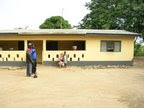 Elaine and I woke up and saw in the day light what the village looked like. This was Madame's house, made of cement and painted a cheerful yellow color. It was definitely the nicest house around, as they ranged down to mud and thatch huts, which also looked quite comfortable. Still, when the rainy season comes, it must be nice to know that you have a tin roof over your head and your house isn't going to melt around you.
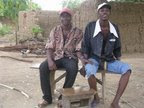 We spent Friday touring around the village, and Senam showed us around one half of it. He knew everybody! It was crazy. He hasn't been here in years and everybody who we saw happily acknowledged us and talked to him. Elaine and I don't speak Ewe (the local language) so the typical routine went something like this: we would come up on a new place, the people would greet us in Ewe (Senam taught us how to say "How are you?" ("Ef oah"), "I'm fine" ("Ehhh" just like Fonzi would say it :-) ), and "thank you" ("Yo" with an extended "o") the only three phrases you really need in any community in Ghana), they would offer us a place to sit and they would talk to Senam in Ewe for some time while Elaine and I sat in silence or compared observations of the chickens and children running around or thinking about what it would be like to grow up in such a small community where the children in gangs are really mostly taking care of themselves.
 At one point we stopped by the house that Senam used to live in, and I took out my camera. I was spotted by a small group of kids and one of them, clearly under peer pressure, bravely stepped forward and asked if I would take a picture of him. I agreed, and he sat down. Right after, swarms of kids came from out of the woodwork and crowded into the shot. It was really cute, and, if you can't tell, Elaine joined them for a group shot.
We moved then down to the riverside, the source of life for the people here. When the government built the dam at Akosombo, they had to flood the upstream and downstream areas, which left Adidopke under water for some years. The villagers all moved up the hills abandoning everything because of the promise that they would have clean piped water and electricity (promises which have yet to be kept after over forty years). They have managed to survive because of the water that flows down the Volta and the seafood that lives in it.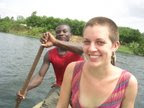 We went for a swim and a short canoe ride upstream, and sat by the bank before we returned home for lunch- rice with pepper sauce and little crawdads (we ate the shells and everything). Various cats and chickens squabbled at my feet looking for scraps.
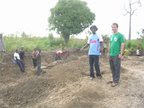 We took a short walk through the other side of our village. One of the consequences of the river flood was the deposition of brilliantly white seashells in the ground everywhere. They are reminiscent of the shell mounds in California. Some townspeople were working to sift the sand and literally mine the shells, which are crushed and used to produce paint and white wash in bigger towns. We asked what the working conditions were like and got no answer, then asked a supervising man what the working hours were. He told us 7am-4pm, and when Elaine pointed out that it was almost 5 he muttered something about overtime. We lounged around and met more people of the village before we returned home and found out they had put a gas-powered generator on to make us more comfortable.
 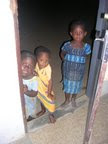 The noise was so loud you couldn't hear anything, but groups of kids came from all over the place to see what could merit such an occasion. I was reading and Elaine was writing in her journal as the kids stared at us, but one brave one followed by others climbed up and started talking to us. I gave him and his friend my book to practice reading English. I then promptly remembered that the book was "The Adventures of Huckleberry Finn" written in southern slang, and I tried to get it back before I ruined the literacy rate of the village, but they were attached to it, looking at the cover and the maps of the US inside. Elaine started drawing in her journal and ripped out paper for the kids to do the same. Eventually the gas ran out and we went back to sleep.
 That night we had a fire outside with some of Senam's friends like Zach and really focused on his cats. There are three kittens by the momma cat, and Elaine and I ended up telling cat stories to each other. We then all crashed and spent our last night in the village.
 When we woke up the next morning, we had our traditional breakfast of bread with peanut butter (called "groundnut paste" here, and we see people actually mashing the nuts. It looks tough, but the result is amazingly delicious for peanut butter), tea, cream and sugar. We said goodbye to Madame, to her helper in this photo with Elaine who refused to tell us her name out of shyness, and to Madame's church group (called the Amens by the townspeople because they say "Amen" so often). We gathered in a group to pour a libation of local gin to the gods to pray for a safe journey home, which involved each of us taking a shot at 9:30am. We got a taxi to a junction and tried to hail a tro-tro there, but it took a long time because they were mainly filled up. We eventually got back to Tema, had another lunch with Mary who was very kind to us and noticed my watch band was broken so she had it stitched up. We then were instructed to have another lunch time shot of gin to express gratitude for our safe arrival, and then Senam found us a tro-tro back to Legon while he boarded a different one to his university. Elaine and I rode home mostly in silence absorbing what it felt like to live for a few days in a really small village with no electricity where very little changes, but where the people all knew each other and where they lived so well. It was really an amazing sight. But in some ways, it was nice to be back in Legon where each day is different and new things happen.
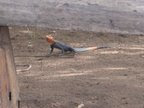
As a post-script, I finally got a good picture of the crazy lizards that are everywhere here. This is what they look like :-)
 Elaine and I woke up and saw in the day light what the village looked like. This was Madame's house, made of cement and painted a cheerful yellow color. It was definitely the nicest house around, as they ranged down to mud and thatch huts, which also looked quite comfortable. Still, when the rainy season comes, it must be nice to know that you have a tin roof over your head and your house isn't going to melt around you.
 We spent Friday touring around the village, and Senam showed us around one half of it. He knew everybody! It was crazy. He hasn't been here in years and everybody who we saw happily acknowledged us and talked to him. Elaine and I don't speak Ewe (the local language) so the typical routine went something like this: we would come up on a new place, the people would greet us in Ewe (Senam taught us how to say "How are you?" ("Ef oah"), "I'm fine" ("Ehhh" just like Fonzi would say it :-) ), and "thank you" ("Yo" with an extended "o") the only three phrases you really need in any community in Ghana), they would offer us a place to sit and they would talk to Senam in Ewe for some time while Elaine and I sat in silence or compared observations of the chickens and children running around or thinking about what it would be like to grow up in such a small community where the children in gangs are really mostly taking care of themselves.
 At one point we stopped by the house that Senam used to live in, and I took out my camera. I was spotted by a small group of kids and one of them, clearly under peer pressure, bravely stepped forward and asked if I would take a picture of him. I agreed, and he sat down. Right after, swarms of kids came from out of the woodwork and crowded into the shot. It was really cute, and, if you can't tell, Elaine joined them for a group shot.
We moved then down to the riverside, the source of life for the people here. When the government built the dam at Akosombo, they had to flood the upstream and downstream areas, which left Adidopke under water for some years. The villagers all moved up the hills abandoning everything because of the promise that they would have clean piped water and electricity (promises which have yet to be kept after over forty years). They have managed to survive because of the water that flows down the Volta and the seafood that lives in it.
 We went for a swim and a short canoe ride upstream, and sat by the bank before we returned home for lunch- rice with pepper sauce and little crawdads (we ate the shells and everything). Various cats and chickens squabbled at my feet looking for scraps.
 We took a short walk through the other side of our village. One of the consequences of the river flood was the deposition of brilliantly white seashells in the ground everywhere. They are reminiscent of the shell mounds in California. Some townspeople were working to sift the sand and literally mine the shells, which are crushed and used to produce paint and white wash in bigger towns. We asked what the working conditions were like and got no answer, then asked a supervising man what the working hours were. He told us 7am-4pm, and when Elaine pointed out that it was almost 5 he muttered something about overtime. We lounged around and met more people of the village before we returned home and found out they had put a gas-powered generator on to make us more comfortable.
  The noise was so loud you couldn't hear anything, but groups of kids came from all over the place to see what could merit such an occasion. I was reading and Elaine was writing in her journal as the kids stared at us, but one brave one followed by others climbed up and started talking to us. I gave him and his friend my book to practice reading English. I then promptly remembered that the book was "The Adventures of Huckleberry Finn" written in southern slang, and I tried to get it back before I ruined the literacy rate of the village, but they were attached to it, looking at the cover and the maps of the US inside. Elaine started drawing in her journal and ripped out paper for the kids to do the same. Eventually the gas ran out and we went back to sleep.
***
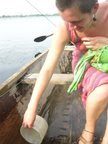 The next day we walked to the next village (very similar) and caught a boat back across the river (Elaine occasionally bailed out the boat).
  We took a taxi to the town of Bator, the largest town around. Senam kept saying "Theo, this is Bator. Have you seen it? Yeah." He has a lot of little expressions that make us all smile. On the way we passed this tro-tro. They always have something written on the back, but I particularly liked this one: "Pray until something happens".
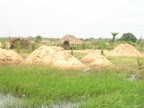 When we got to Bator, we met an old friend of Senam's named Fortune (some Ghanaians pick their own Western names so while many call themselves biblical names like Isaac or Mary, some have more creative names like Precious). She was very sweet, gave us water (a good sign in a host) and walked with us until we got to the bank where she works. We then continued on until we got to the river side and saw people just carrying sand in baskets on their heads. It was here we met Simple, another of Senam's friends who owns about half of the land in Bator.
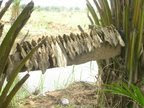 He brought us a bunch of bananas and we ate them outside next to this rack of pig jaws that he has saved from the pigs he has hunted and eaten.
We sat by the river for a little while talking before Simply decided he would just take off from work.
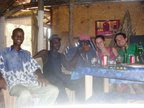 We walked to a bar in town and were treated to quite a lot of drinks and snacks. It is considered rude to turn down food or drink in Ghana, but right when we finished something another drink would come out, so we ended up nursing drinks until it was time to go. Simple had hired a private photographer to come and take a picture of all of us together (which was odd, and made both of us feel a little like a fancy decoration to be shown off later). It also made me extremely uncomfortable to spend the afternoon with somebody who has so much and managed an operation of laborers carrying really heavy sand to trucks for construction in Accra in the hot sun all day. We eventually left and returned
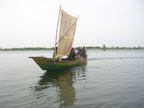 to Adidopke by boat, but this one had a cool sail made out of old flour sacks. Reduce, reuse, recycle. It looked like it really helped a lot too.
 The next day we walked to the next village (very similar) and caught a boat back across the river (Elaine occasionally bailed out the boat).
  We took a taxi to the town of Bator, the largest town around. Senam kept saying "Theo, this is Bator. Have you seen it? Yeah." He has a lot of little expressions that make us all smile. On the way we passed this tro-tro. They always have something written on the back, but I particularly liked this one: "Pray until something happens".
 When we got to Bator, we met an old friend of Senam's named Fortune (some Ghanaians pick their own Western names so while many call themselves biblical names like Isaac or Mary, some have more creative names like Precious). She was very sweet, gave us water (a good sign in a host) and walked with us until we got to the bank where she works. We then continued on until we got to the river side and saw people just carrying sand in baskets on their heads. It was here we met Simple, another of Senam's friends who owns about half of the land in Bator.
 He brought us a bunch of bananas and we ate them outside next to this rack of pig jaws that he has saved from the pigs he has hunted and eaten.
We sat by the river for a little while talking before Simply decided he would just take off from work.
 We walked to a bar in town and were treated to quite a lot of drinks and snacks. It is considered rude to turn down food or drink in Ghana, but right when we finished something another drink would come out, so we ended up nursing drinks until it was time to go. Simple had hired a private photographer to come and take a picture of all of us together (which was odd, and made both of us feel a little like a fancy decoration to be shown off later). It also made me extremely uncomfortable to spend the afternoon with somebody who has so much and managed an operation of laborers carrying really heavy sand to trucks for construction in Accra in the hot sun all day. We eventually left and returned
 to Adidopke by boat, but this one had a cool sail made out of old flour sacks. Reduce, reuse, recycle. It looked like it really helped a lot too.
 That night we had a fire outside with some of Senam's friends like Zach and really focused on his cats. There are three kittens by the momma cat, and Elaine and I ended up telling cat stories to each other. We then all crashed and spent our last night in the village.
 When we woke up the next morning, we had our traditional breakfast of bread with peanut butter (called "groundnut paste" here, and we see people actually mashing the nuts. It looks tough, but the result is amazingly delicious for peanut butter), tea, cream and sugar. We said goodbye to Madame, to her helper in this photo with Elaine who refused to tell us her name out of shyness, and to Madame's church group (called the Amens by the townspeople because they say "Amen" so often). We gathered in a group to pour a libation of local gin to the gods to pray for a safe journey home, which involved each of us taking a shot at 9:30am. We got a taxi to a junction and tried to hail a tro-tro there, but it took a long time because they were mainly filled up. We eventually got back to Tema, had another lunch with Mary who was very kind to us and noticed my watch band was broken so she had it stitched up. We then were instructed to have another lunch time shot of gin to express gratitude for our safe arrival, and then Senam found us a tro-tro back to Legon while he boarded a different one to his university. Elaine and I rode home mostly in silence absorbing what it felt like to live for a few days in a really small village with no electricity where very little changes, but where the people all knew each other and where they lived so well. It was really an amazing sight. But in some ways, it was nice to be back in Legon where each day is different and new things happen.
As a post-script, I finally got a good picture of the crazy lizards that are everywhere here. This is what they look like :-)
Subscribe to:
Posts (Atom)
